Vigía reads the protocol and builds the study. It checks each entry at the point of care, then signs, bills and reconciles from the same record. What is already written is read, not re-typed, and every number traces back to its source.
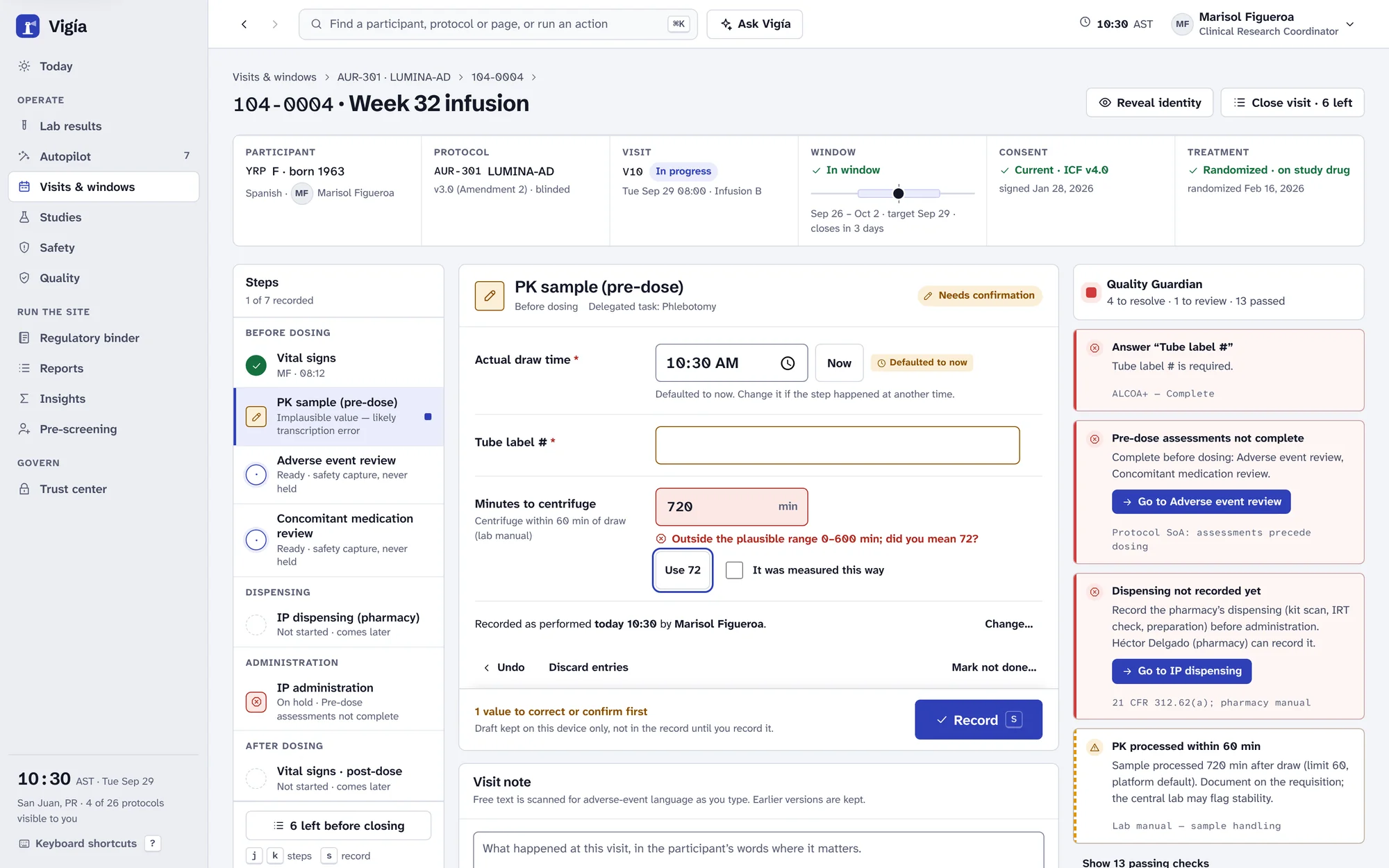
Animated example from the prototype. A coordinator types 720 minutes to centrifuge. The Guardian asks whether she meant 72. She accepts, and the value is recorded, flagged as above the 60-minute limit. Consent is current and the task is delegated. Dosing waits, with the reason: pre-dose assessments are not complete.
Outside the plausible range 0–600 min; did you mean 72?Use 72
Recorded as performed today by Marisol Figueroa.Record
Quality Guardian Checks as typed
1Consent is currentCurrent · ICF v4.0, signed Jan 28, 2026
2The task is delegatedDelegated task: Phlebotomy
3Values are checked as they’re typedChecking…720 minutes? Did you mean 72?72 minutes. A plausible value.
Before anything is recorded.Before anything is recorded.ALCOA+ (accurate)Recorded, and flagged: above the 60-minute limit.
4Dosing waits, with the reasonPre-dose assessments not complete. Protocol SoA: assessments precede dosing.
Designed around
21 CFR Part 11 e-records & signatures
ICH E6(R3) GCP
FDA eSource guidance
21 CFR 50 · 54 · 56 · 312
Control map regulation by regulation
21 CFR Part 11 e-records & signatures
ICH E6(R3) GCP
FDA eSource guidance
21 CFR 50 · 54 · 56 · 312
Control map regulation by regulation
Guardian51Rules at the point of care
Reports12Financial reports, each tied to the books
Platform13Real screens from the prototype
Demo5minFrom one PDF to the last dollar
One visit, four checks
Every pin is a rule that’s running right now.
The coordinator typed 720 minutes to centrifuge. Vigía asks whether she meant 72, and holds dosing until the pre-dose steps are done. Pick a pin to see the rule and where it comes from.
Visits · 104-0004 · Week 32 infusion
Pin 3 of 4 · real screen from the prototype
Why switch
The reading, the typing and the remembering, done for you.
Coordinators spend their days re-reading protocols and re-typing values across systems. Vigía takes that work off their desk and leaves every decision with the people accountable for it.
Someone reads every page of the protocol and keeps the rules in their head.
Vigía reads it and cites where each value came from.
The study is built by hand, and every value is typed twice.
Confirm each value once and the study is built, rules already in place.
Mistakes surface at the monitoring visit, weeks later.
The Guardian catches them at the point of care, while they can still be fixed.
How it works
One record, from the protocol to the payment.
A value confirmed during the build is the value the Guardian checks at the visit, the investigator signs, and the sponsor is billed for.
01
Read the documents
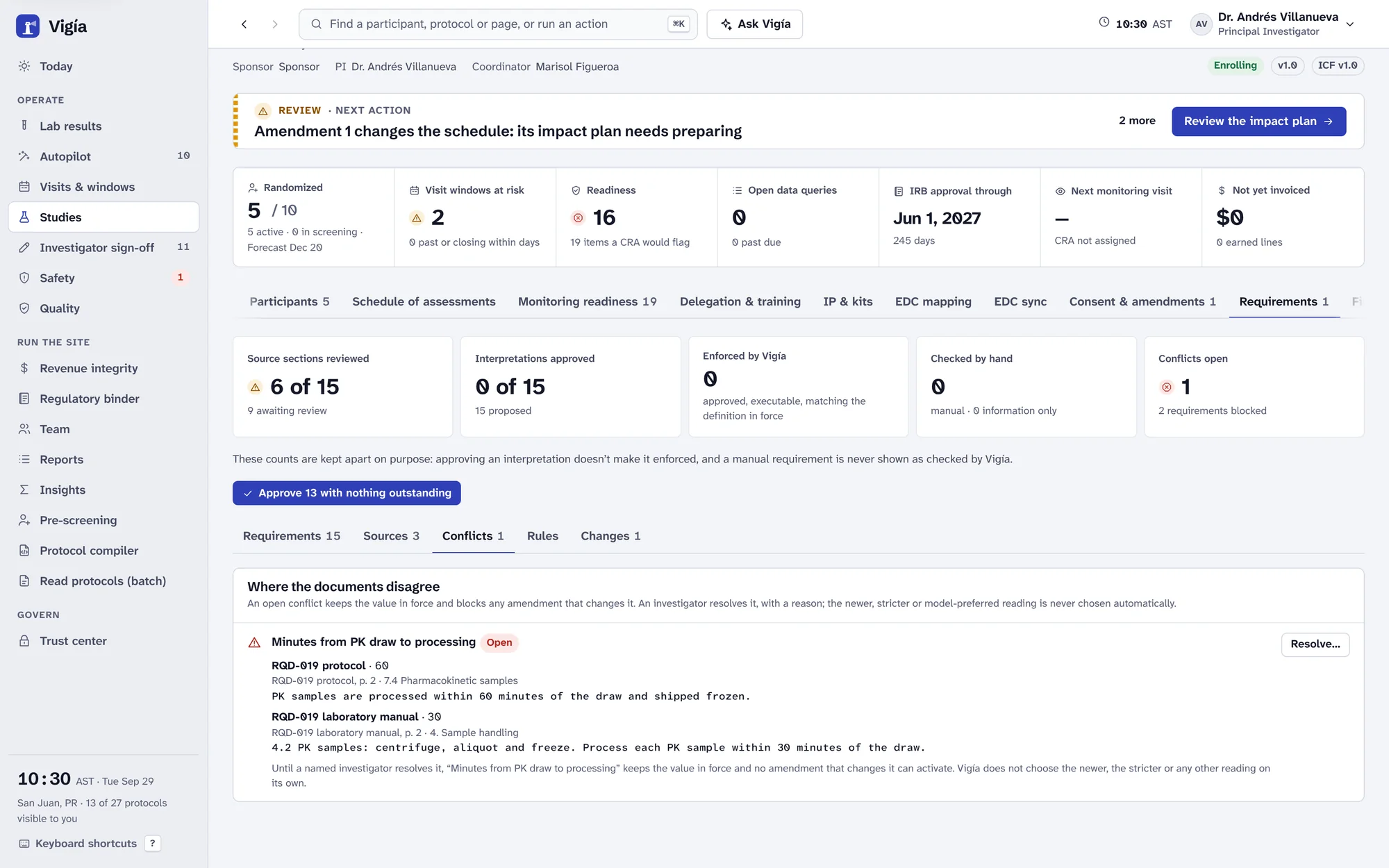
Protocol, amendments, lab manual and CTA budget become a requirement registry. Each requirement cites the page that states it; one Vigía can’t find is marked uncited. When sources disagree, an investigator decides, with a reason.
Study · Requirements · Conflicts
Real screen from the prototype
Example
!Minutes from PK draw to processingTwo sources disagree. Vigía won’t pick one.Open
Protocol60 min
Lab manual · p. 2 · §4.230 min
3Investigator decides, with a reasonThe resolution is attributable and audited.
02
Build the study
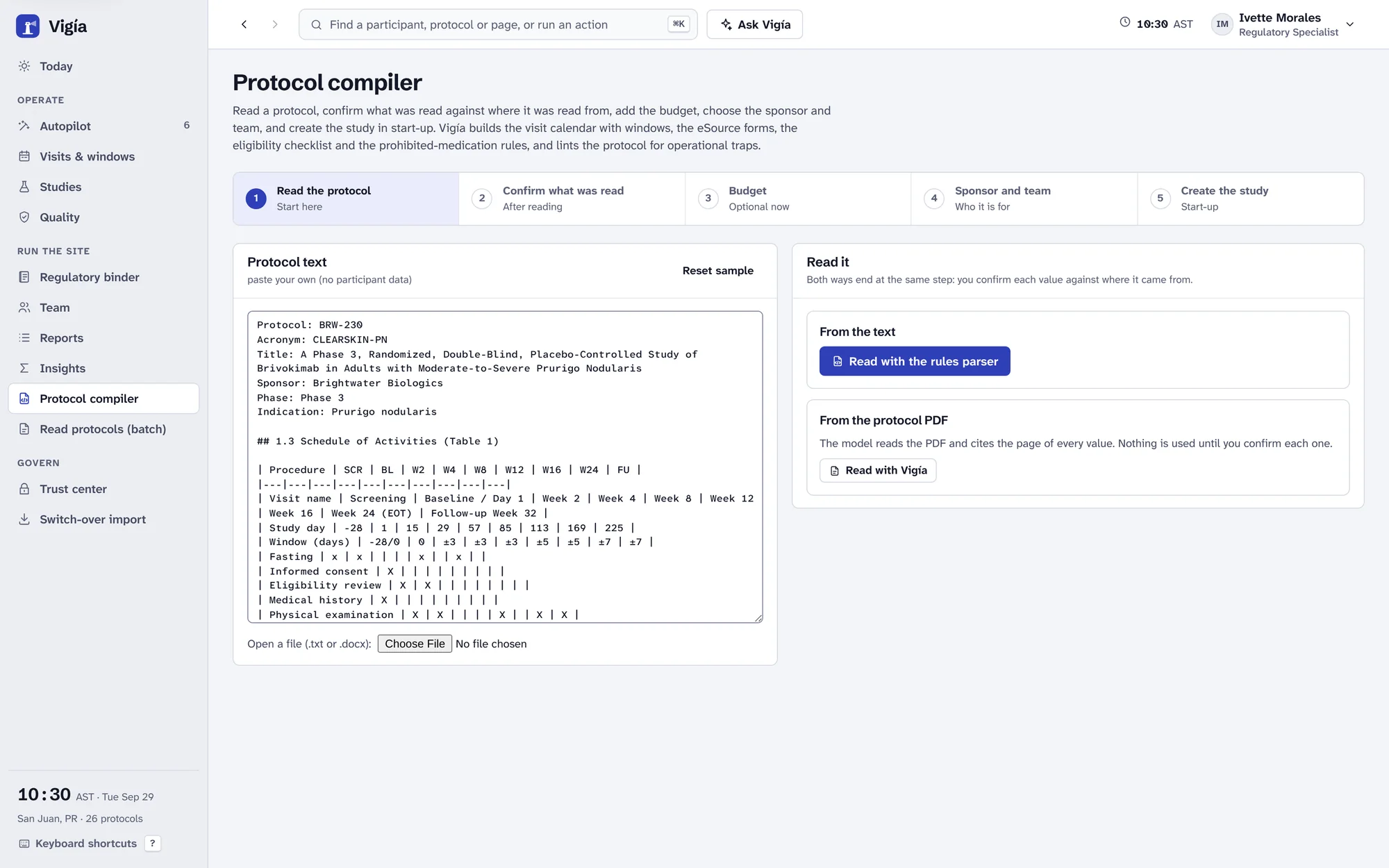
Schedule of activities, visit windows by cohort, eligibility, prohibited medications and budget. A person confirms each value before it goes live.
Protocol compiler
Real screen from the prototype
Example
Schedule of activities
Visit windows by cohort
Eligibility and prohibited medications
Budget
Every value confirmed by a person before the study goes live.
03
Consent the participant
Paper or eConsent, in person or remote. Only the IRB-approved version for that language, with witness, legal representative and minors handled as the IRB ruled.
Consent
Real screen from the prototype
Example
PapereConsentIn personRemote
1Consent is currentCurrent · ICF v4.0, signed Jan 28, 2026IRB-approved
Witness · legal representative · parental permission and assentAs the IRB ruled.
A new version is approvedRe-consent is flagged.Re-consent
04
Run the visit
eSource at the point of care. Dosing waits for the pre-dose steps. Delegation and training are checked at the moment of each act. Corrections keep the original.
Visits · 104-0004 · Week 32 infusion
Real screen from the prototype
Example
Vital signsRecorded
2PK sample (pre-dose)720 minutes? Did you mean 72?Needs confirmation
3Adverse event review
4IP administrationDosing waits for the pre-dose steps.On hold
05
Sign
Signatures carry name, time and meaning and are bound to the exact record. Change it afterwards and the signature shows as broken.
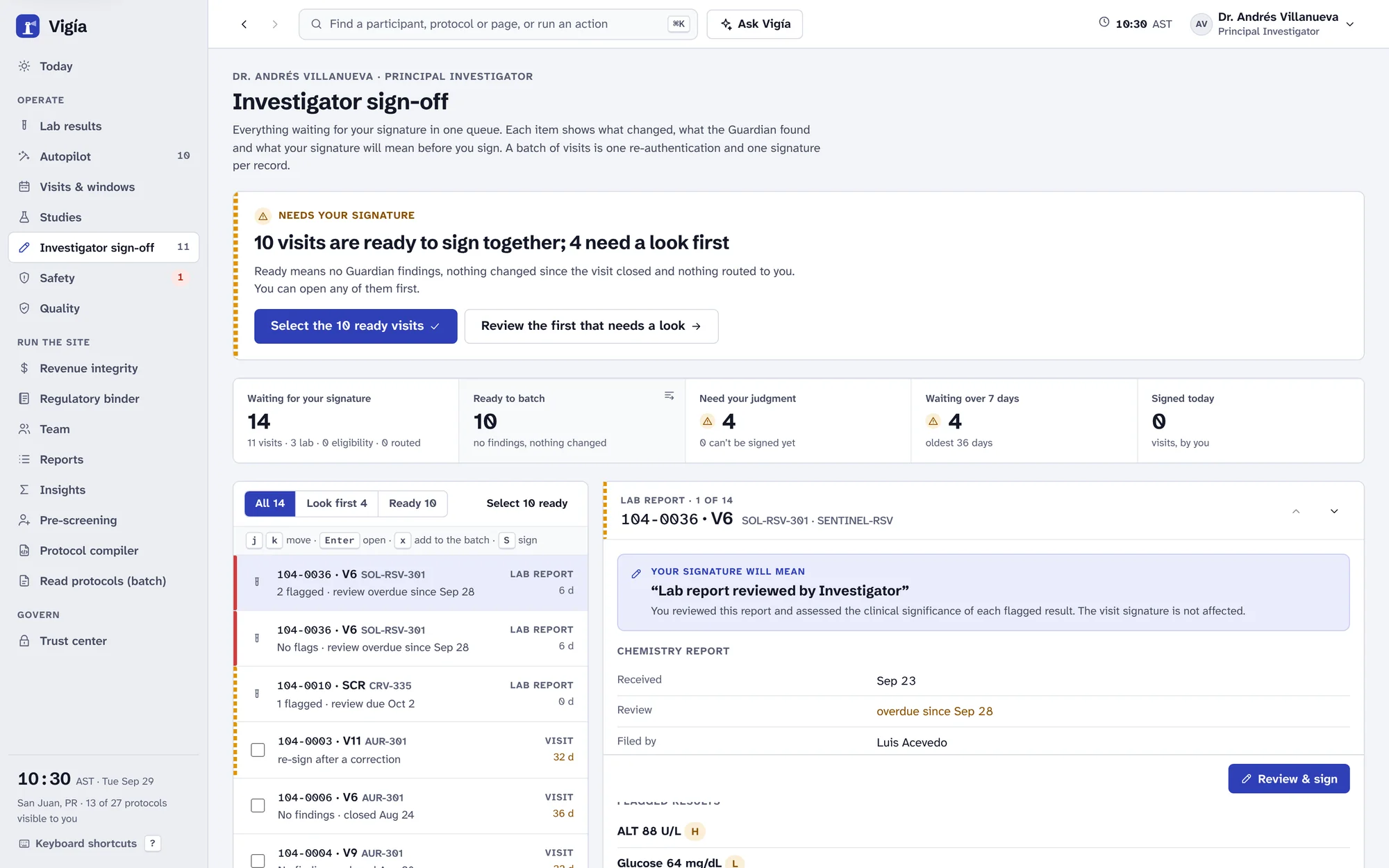
Investigator sign-off
Real screen from the prototype
Example
Signature intactSignature broken
Principal Investigator
Printed name, date, time and meaning, bound to a hash of the exact record. Signing re-authenticates with password and authenticator code.
06
Get paid
Completed work earns its fee at the price in force on the day it was done. Invoices, payments and holdback reconcile to the cent.
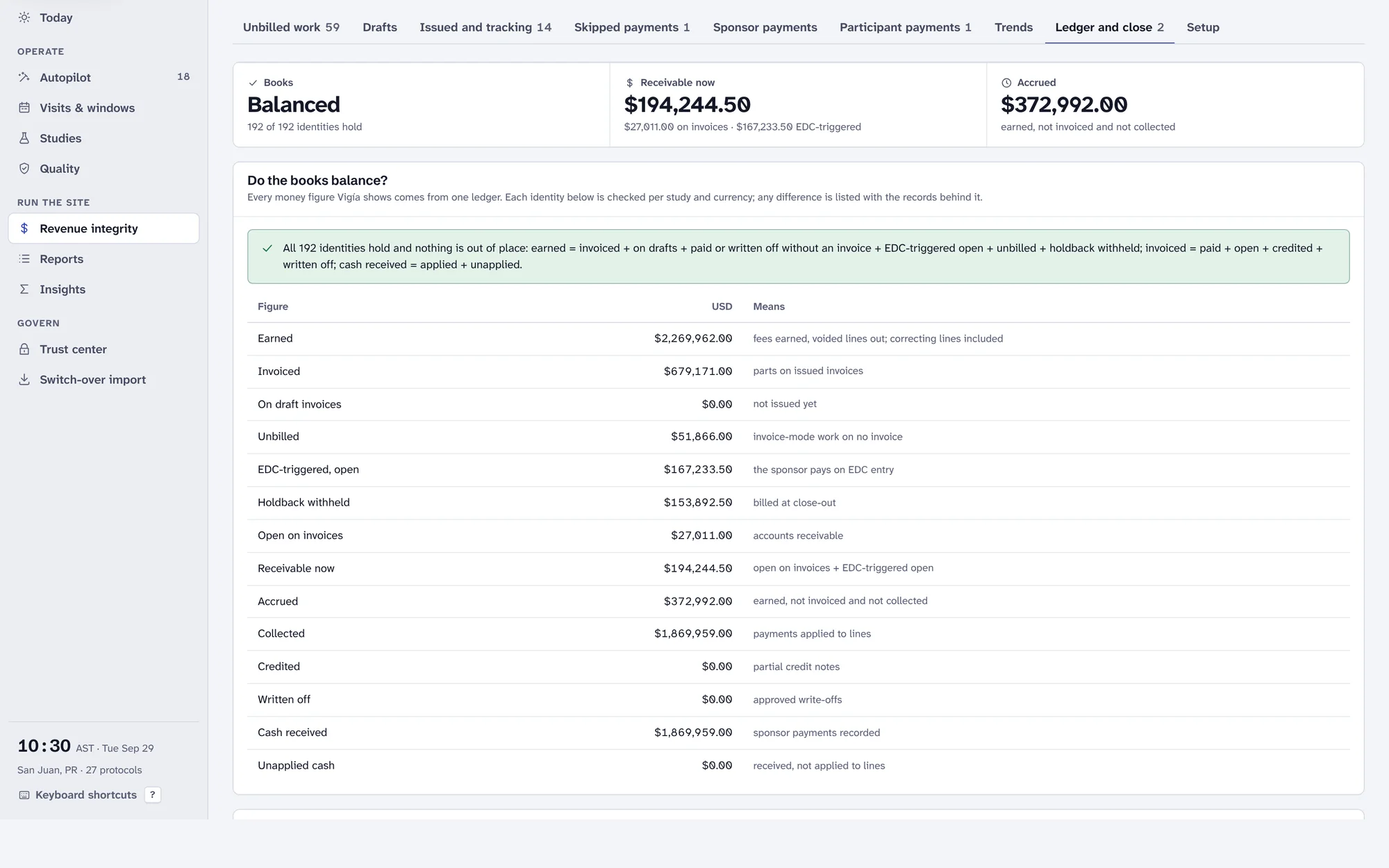
Revenue · Ledger and close
Real screen from the prototype
Example
Receivable now · synthetic site
$194,244.50
Invoiced = paid + open + credited + written offHolds
Cash received = applied + not yet appliedHolds
07
Change safely
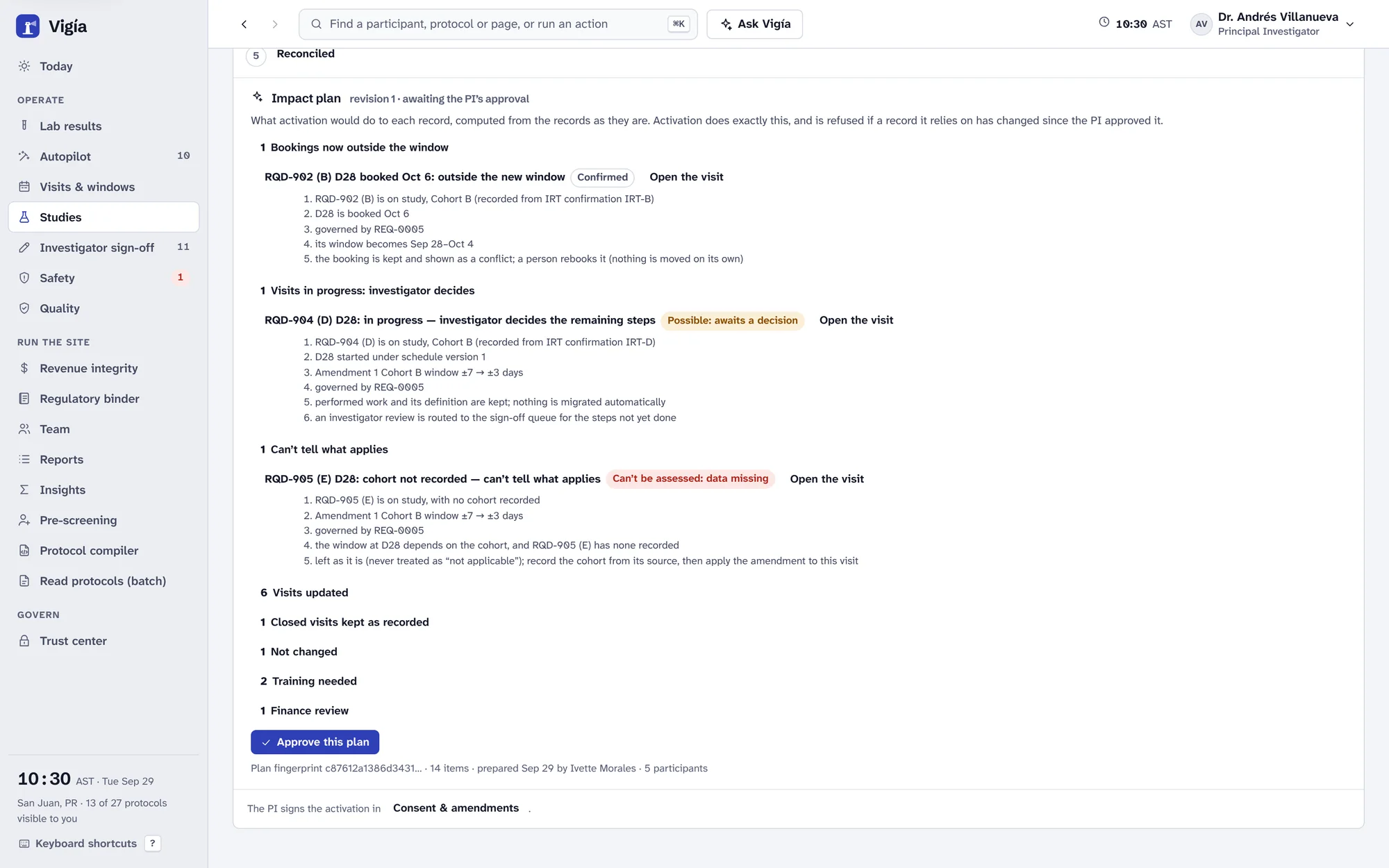
An amendment gets an impact plan, participant by participant, before anything moves. The investigator approves and signs; follow-up work is waiting.
Study · Changes · Amendment 1
Real screen from the prototype
Example
A booking outside the new windowComputed from the records as they are.Review
A visit underwayThe investigator decides the remaining steps.Review
A cohort never recordedFollow-up work is created on activation.Follow-up
Approved and signed by the investigator
08
Welcome the inspector
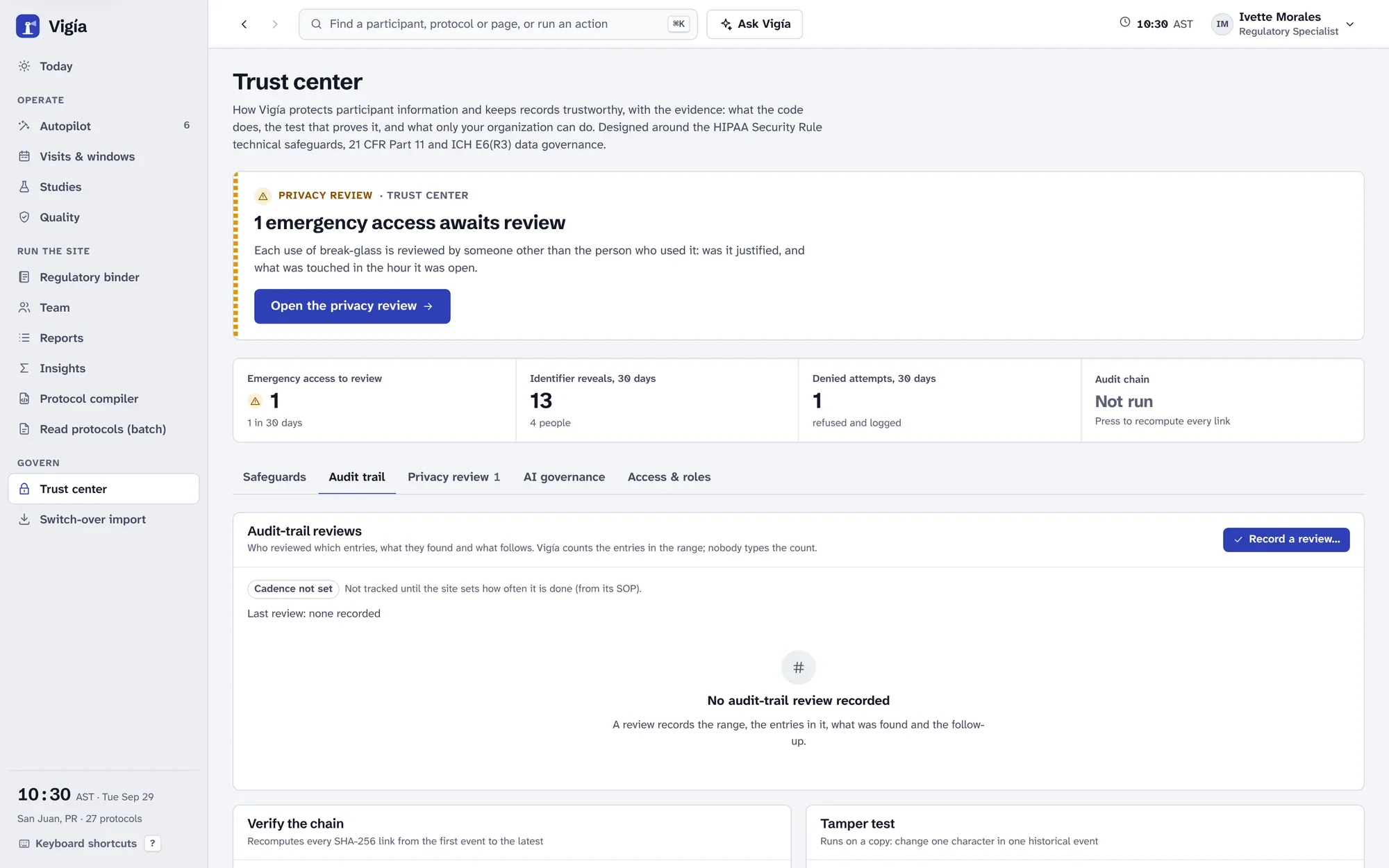
Monitors and inspectors get scoped, time-limited access to their studies. Certified copies, a structured export and the full audit trail are ready to hand over.
Trust center · Audit trail
Real screen from the prototype
Example
Monitor · InspectorScoped, time-limited access to their studies.Expires
entry #1041entry #1042entry #1043
Append-only, hash-chained audit trail. Certified copies and a structured export are ready to hand over.
Try the Guardian
It catches the mistake before it’s recorded.
Change the processing time. The Guardian checks it against this study’s own limit as it’s typed, and shows the page the limit came from.
Try
51 rules at the point of care: windows, fasting, dosing order, consent, delegation, training, IRB status and stopping rules.
Holds what must wait and records what happened, with the reason.
Every finding cites its source: the regulation or protocol section behind the rule, and the document, version and page where the study’s documents are registered.
RQD-019 · Day 28 visit · Cohort BFictional study
Vital signsRecorded 09:02
PK sample drawn09:12
Off the scale
Limit 30
0306090min
42 minutes from draw to processing. This study’s limit is 30.
RQD-019 laboratory manual · p. 2 · §4.2 (the investigator chose the lab manual)“Process each PK sample within 30 minutes of the draw.”
Guardian · PK processingA late sample is still recorded, with the reason, and flagged.
What makes Vigía different
Most site software stores what happened. Vigía knows what should.
Because it has read the protocol, Vigía can tell whether what’s happening now is right, and show you why.
01 · Traceability
Every rule traces to its source
Windows, procedures, limits and fees carry their source: document, version, page and quoted text where the document is registered. When the protocol and the lab manual disagree, Vigía won’t pick one.
ProtocolMinutes from PK draw to processing: 60
vs
Lab manual · p. 2 · §4.2Process each sample within 30
02 · Point of care
A Guardian at the point of care
51 rules run while the work happens, instead of in a monitoring visit weeks later. Each holds what must wait and records what happened, with the reason.
Vigía reads lab reports, budgets and protocols and drafts the values. Nothing becomes a record until a qualified person confirms it, and the AI’s proposal is kept beside what the person entered.
Lab report · read by VigíaFictional
Potassiump. 14.1 mmol/LConfirmedby the coordinator
Creatininep. 10.92 mg/dLConfirmedby the coordinator
Clinical significanceInvestigator’s callNever proposedjudgment stays human
Ask Vigía answers questions about your studies, read-only, inside your role’s view.
Autopilot prepares visit rebookings, invoices, query answers and follow-ups. None of it goes out until a named person approves it.
Eligibility, causality and seriousness are signed by an investigator. The AI never decides them.
04 · One record
One system, one record
A visit completed once updates the schedule, the EDC queue and the ledger. No exports between the site’s own tools, no second copy to reconcile.
A visit completed once
the schedulethe EDC queuethe ledger
CTMSeSourceeRegeConsentIPpaymentsbilling
05 · Amendments
Amendments with an impact plan
Before a protocol change takes effect, Vigía shows what it will do to each participant. If a record changes after approval, activation is refused until the plan is reviewed again.
Plan is staleActivation refused
Follow-up tasksWaiting
06 · Inspection
Built for inspection
An append-only, hash-chained audit trail, Part 11 signatures bound to their records, and validation templates (requirements, risk assessment, IQ/OQ/PQ protocols, traceability to tests) to support your own validation.
Control map21 CFR Part 11ICH E6(R3)
5:00
Product demo
A whole study, from one PDF to the last dollar.
Five minutes, recorded from the working product. Choose a chapter to jump straight to it.
Recorded when the Guardian had 44 rules; it has 51 today.
–Press play, or pick a chapter5:00
Loading the demo…
Chapters, 14
Read the transcript
Cold open
Every clinical trial begins with a protocol, and a person who has to read every page of it. Then someone builds the study by hand, types every value twice, and remembers every rule. Miss one step, and the study pays for it. What if the software did the reading, the typing, and the remembering? Meet Vigía. The AI operating system for clinical trial sites. From Perpetua AI.
One PDF in, a whole study out
It starts where every study starts. Hand it the protocol, and Vigía reads it, page by page. Nine visits and sixteen procedures, with every window and fasting rule, become a schedule of activities. Nine eligibility criteria. Three classes of prohibited medication. The budget. Each value cites the page it came from. It even prices the study against your site’s own costs. Confirm each value, and the study is built, its Guardian rules already in place.
The Guardian
At the visit, Vigía checks every value as it’s entered. Seven hundred and twenty minutes to centrifuge? Did you mean seventy-two? The dose stays on hold until the pre-dose steps are done, and it cites the rule that says so. Forty-four rules, watching every act at the point of care. It stops the mistake, never the record.
When the protocol changes
Every rule traces back to the page that wrote it. When the protocol and the lab manual disagree, Vigía won’t pick one. An investigator decides, and says why. And when the protocol changes, Vigía shows what the amendment will do, participant by participant, before anything moves. A booking that no longer fits. A visit already underway. A participant whose cohort was never recorded. Each one, with its reason. The investigator approves the plan, and signs. The follow-up work is already waiting.
Read, not re-typed
And no one types what’s already written. Take a photo of the paper worksheet. Every value is read, placed in its field, and linked to the box it came from. Or just say it out loud. Coordinator: Seated five minutes. Pressure one twenty-six over eighty. Pulse seventy. Temperature thirty-six point seven. Vigía reads the lab report, and catches what the report missed: a potassium of five point nine, above range, and unflagged. Every value carries its source, and nothing is saved until a person confirms it.
Safety, in Spanish or English
A coordinator writes, in Spanish: se cayó, fue a emergencias. Vigía recognizes a possible adverse event, flags the emergency visit for a seriousness call, and drafts it for the investigator. The serious-event clock runs from the moment the site knew.
Autopilot and Ask
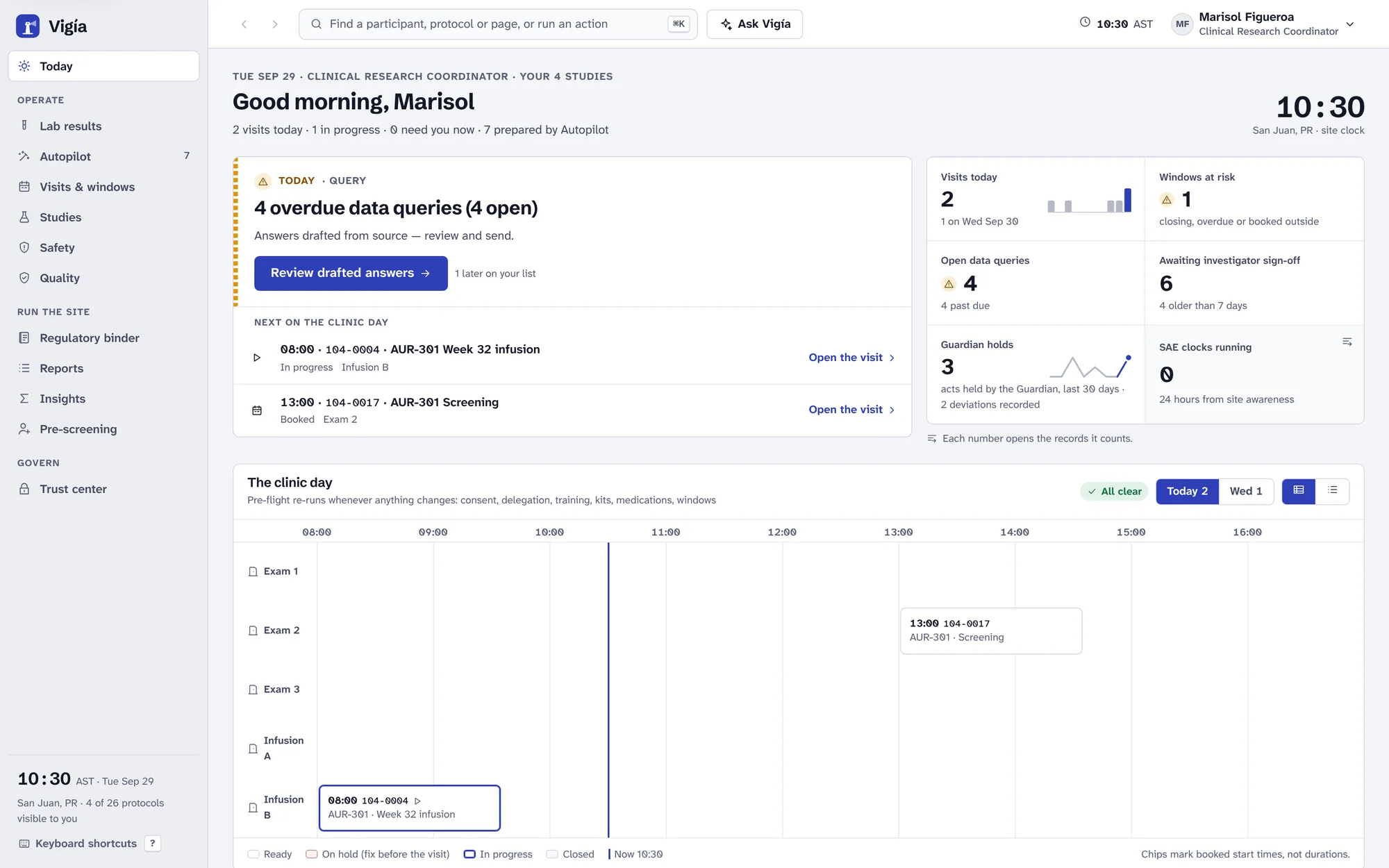
Every morning, Autopilot has the day’s work prepared: query answers drafted from source, visits to book, invoices to draft. Each item shows its evidence. You approve it with one click. And you can simply ask. Which studies are behind on enrollment? Which sponsor is slowest to pay? Every answer links to the records behind it.
Every dollar
Vigía follows every dollar, from finished visit to cash. Forty-six thousand dollars of finished work, not yet invoiced: drafted in one click. A sponsor skipped three visit fees. Vigía caught it, and wrote the dispute letter. Hand it the contract, and it reads the budget, and flags a total that doesn’t add up.
Books that balance
And the books balance, to the cent. Every fee is priced by the budget in force on the day the work was done. Write-offs, and reopening a closed month, take a second person. Twelve financial reports carry the checks that prove them, and go to your accountant in Excel.
Insights
Insights finds what nobody has time to look for: morning vital signs draw queries at four point seven times the site’s rate. Open it, and there are the records behind it.
The whole site
Consent in the participant’s own language. Amendments that re-plan the visits not yet started. Investigational product, accounted for kit by kit. Part eleven electronic signatures. A regulatory binder that tracks its own expirations. One system. One record. The entire site.
Trust
Built with HIPAA’s safeguards at its core: sensitive fields encrypted, every change sealed in a hash chain, every signature re-authenticated. Alter a single character, and the chain shows exactly where. AI runs through a gateway covered by a business associate agreement, and nothing a model returns is saved until a person confirms it.
Every source, accounted for
And every value has a known origin. Each device, instrument and lab system that sends data is on the study’s authorized list. And the investigator signs how the data flows, from capture to the sponsor.
Close
Read, not re-typed. Caught before it happens. Billed when it’s done. Vigía. The AI operating system for clinical trial sites. Built by Perpetua AI.
The platform
One system for everyone at the site.
Real screens from the prototype. Scheduling, eSource, eConsent, the regulatory binder, investigational product, participant payments and billing share one record.
Click the screen to zoom
01/ 13
Finance
Books that balance, to the cent.
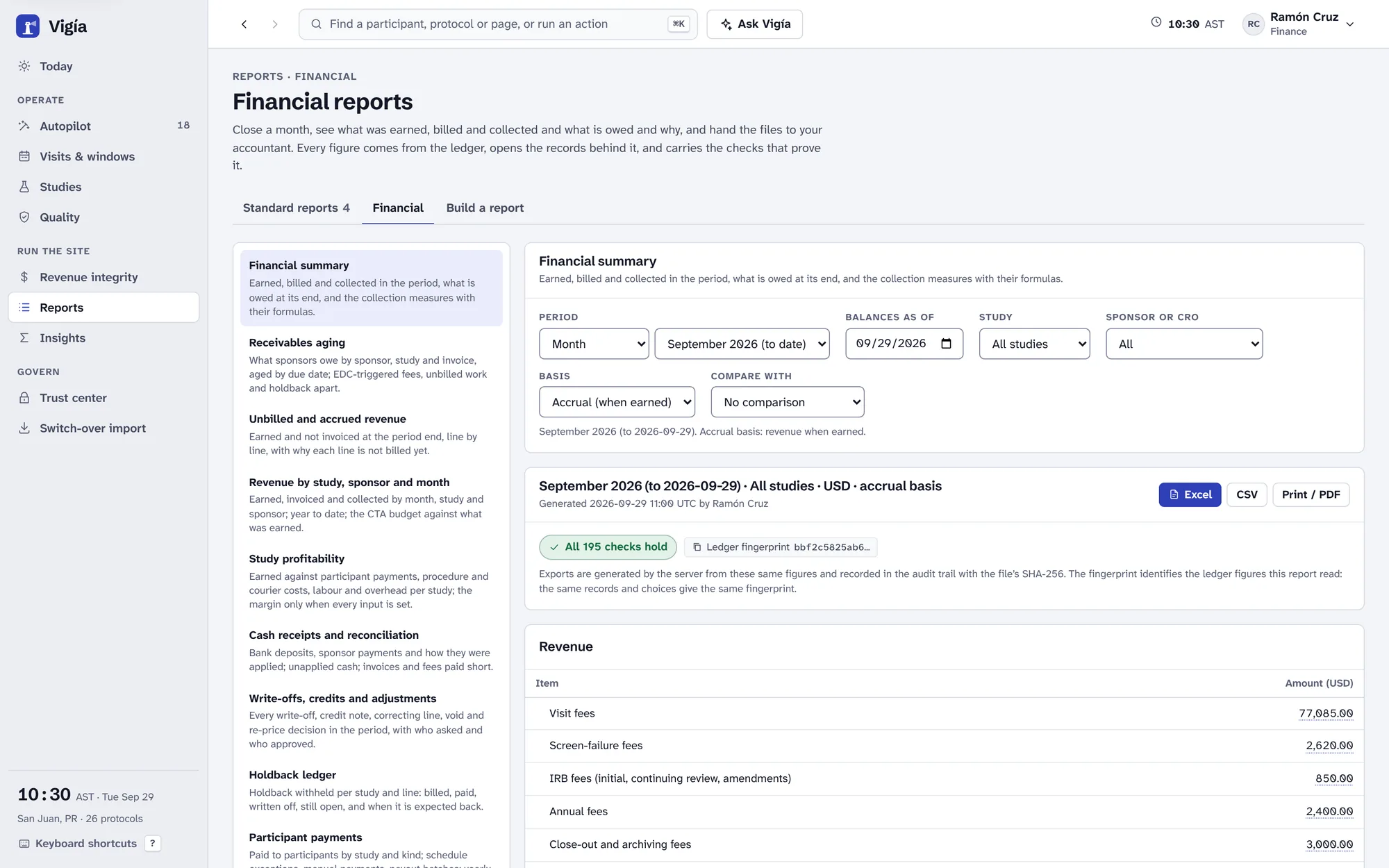
Revenue comes from the clinical record, not a spreadsheet kept on the side. One ledger feeds every money screen and checks itself every time it’s read.
Do the books balance?
Receivable now · synthetic site
$194,244.50
All checks hold
Revenue · Ledger and close
The ledger’s checks, every time it is readRevenue · Ledger and close
Earned = invoiced + on drafts + paid without invoice + written off + EDC-paid open + unbilled + holdback heldHolds
Invoiced = paid + open + credited + written offHolds
Cash received = applied + not yet appliedHolds
Receivables aged by due date add up to what sponsors oweHolds
Any difference is listed with the records behind itDrill down
Earned from the work
A completed visit earns its fee; a visit where nothing was done earns nothing. Start-up, IRB, annual and close-out fees are earned when their event happens.
Priced by the day of service
Every fee comes from the budget version in force on the day the work was done, even when an amendment is entered late.
Never billed twice
A coverage analysis marks each procedure sponsor-paid or standard of care. Standard-of-care items go to the billing office with the NCT number and modifier Q1.
Holdback you can see
Withheld amounts are tracked per line and billed on a holdback invoice at close-out.
Four more ledger rules
Two people for sensitive moves
Write-offs, reopening a closed month and off-schedule participant payments need a second person. Corrections are new lines, never edits.
Month-end close
A fingerprinted snapshot of earned, unbilled, receivables and cash, with a journal export for your accountant.
Participant payments
Paid from the IRB-approved schedule, with yearly totals per person and the IRS reporting threshold for each tax year.
Profit per study
Uses your own staff rates and overhead. Until you enter them, Vigía says “not set” instead of guessing.
12Reports
Twelve financial reports, each one tied to the books.
Pick a period, a basis and a comparison. Every report reads the same ledger, shows the checks that tie it to the books, and hands your accountant a file.
Reports · Financial · Financial summary
eSource
Every value has a known origin.
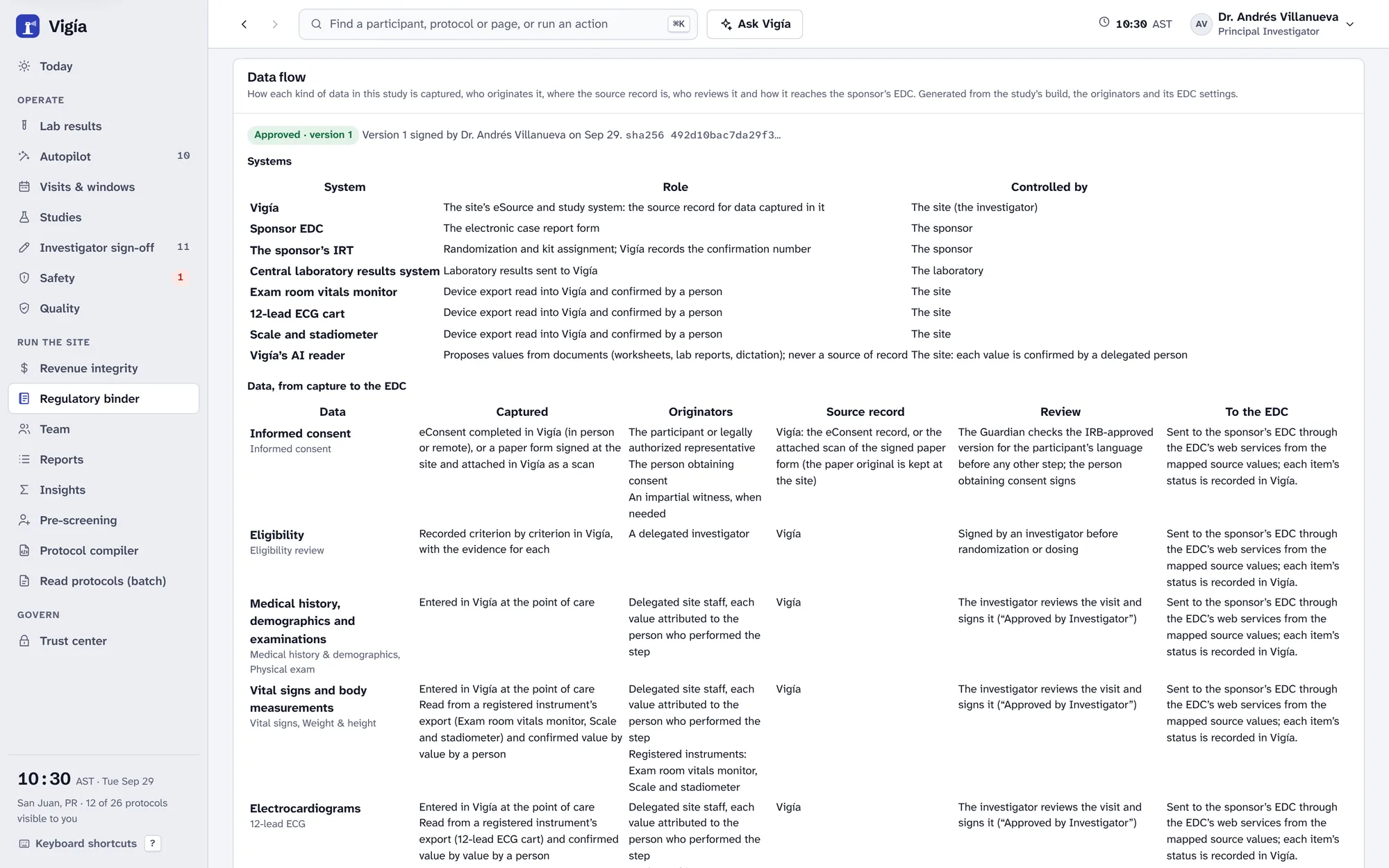
FDA’s guidance on electronic source data calls for a list of every person, device, instrument and system authorized to originate source data, and a description of how the data flows to the sponsor. Vigía keeps the site’s side of both current, and the investigator signs it.
Authorized data originatorsRegulatory binder
1
People come straight from the delegation log, with the tasks each may do
Live
2
Devices and systems are registered with the identifiers they send and their qualification
Registered
3
Device files are read only from a registered device, never guessed
Refused
4
Lab results from a sender not on the list are kept, and flagged
Flagged
5
The data flow shows itself out of date when the study or the list changes
Re-sign
6
The investigator signs the list and the data flow
Signed
Regulatory binder · eSource · Data flow
How the data flow is made and kept
Generated, not written
The data-flow description is built from the study’s visits, its originators and its EDC settings: what is captured, by whom, where the source record is, who reviews it and how it reaches the EDC.
Signed with a Part 11 electronic signature
The investigator approves the exact version reviewed, with re-authentication. Earlier versions are kept with their content and fingerprint.
Attributed at capture
Each device reading carries the device that produced it and the person who confirmed it, on the date it was authorized.
In the study archive
The originator list and the signed data flow go into the archive and the dataset export, ready for a monitor or an inspector.
Compliance
Good Clinical Practice, built into the software.
Designed around ICH E6(R3), adopted by ICH in January 2025 and published by FDA as final guidance in September 2025, and around 21 CFR Parts 11, 50, 54, 56 and 312.
The prototype
See Vigía run a study.
The prototype runs in your browser on fictional studies with synthetic participants. Nothing to install. It needs a password.